
2025 ICYMI Edition
Engagement - Culture - Behaviour Change - Psychosocial Safety


I am continuing the tradition of sharing my favourite posts of the year.
No preamble: Here are the five things that I have most enjoyed sharing with people and talking about in 2025.
Let me know what you make of them!
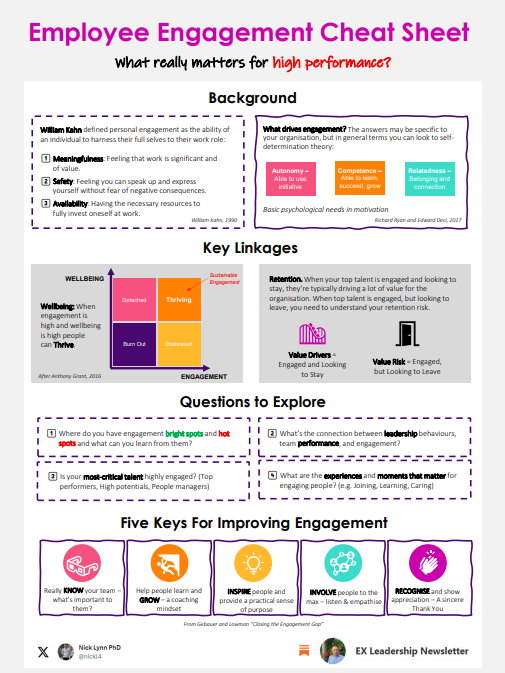
I did my first ever Cheat Sheet this year. Not that surprisingly, it was on employee engagement: theory, evidence, and key questions to ask. Perhaps it’s reassuring to know that when half the content on LinkedIn is AI generated, some of us are still pushing our PowerPoint skills to the absolute limit. I am currently helping to evolve WTW’s approach to engagement in an age of AI and disruption, so there is more to come on this topic in 2026!
https://www.linkedin.com/feed/update/urn:li:ugcPost:7301203851024498689/
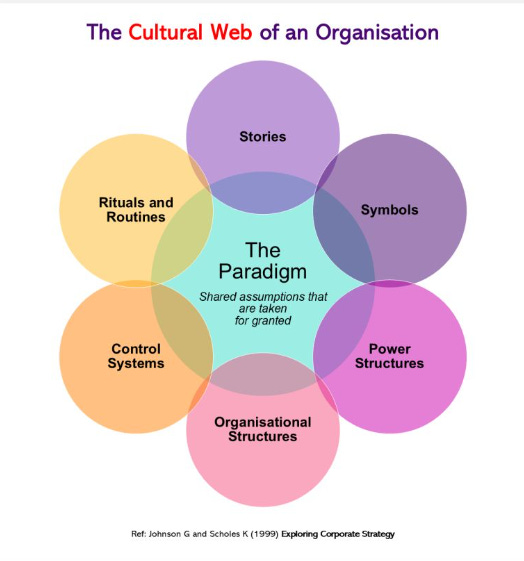
I’ve been sharing a few posts on culture this year (my posts reflect my client work to some extent). I’ve always liked Gerry Johnson and Kevan Scholes’ Cultural Web because it looks at both systems and stories, so it was pleasing to see the reaction and discussion that this post caused.
https://www.linkedin.com/feed/update/urn:li:share:7329094921145970689/
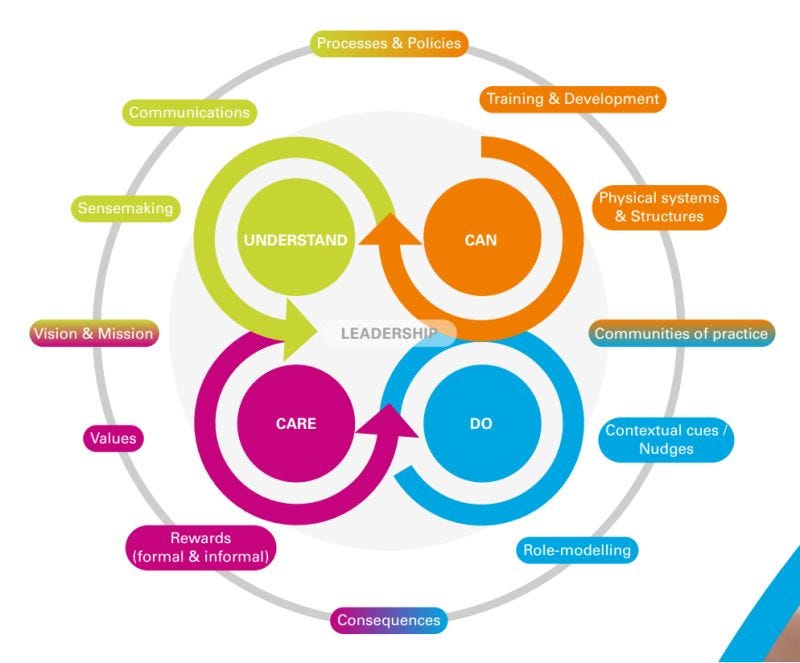
A report by Zara Whysall on how you can apply behavioural science to culture change was one of my favourite reads of the year. She also shows why misalignment, which is often hidden, can pose a serious risk to any organisation. Her “Understand, Care, Can, Do” framework is a very useful distillation.
https://www.linkedin.com/feed/update/urn:li:share:7334169074286956545/
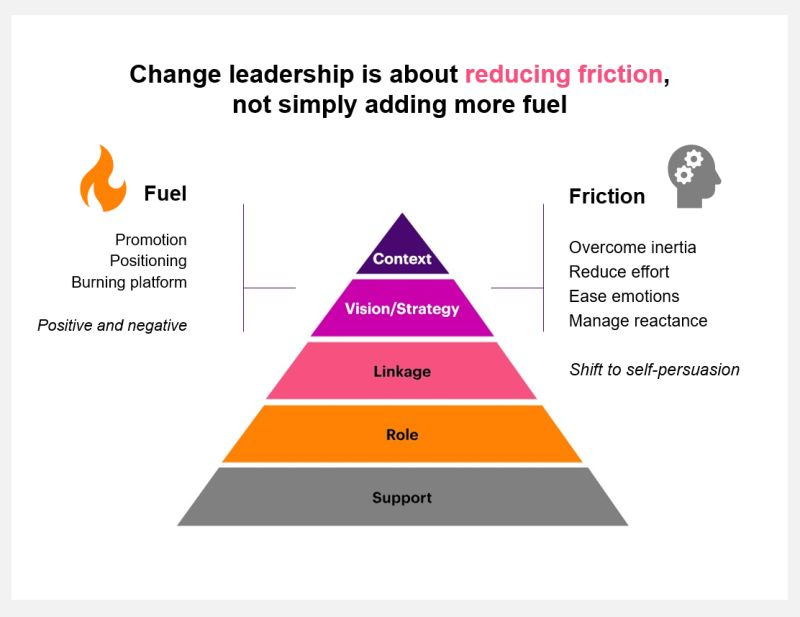
My favourite book of the year was The Human Element by Loran Nordgren and David Schonthal — on the psychology of change. They point out that great change leadership is about understanding and reducing friction, rather than just adding more fuel. My homemade graphic doesn’t do the book justice.
https://www.linkedin.com/feed/update/urn:li:share:7392532619592253440/
Again, reflecting what I’m up to, I have posted a few times on psychosocial hazards. Frameworks like ISO 45003 treat these as occupational health and safety risks that must be identified, controlled and monitored (just like physical hazards). Assessing those risks and identifying ways to mitigate them is really important work.
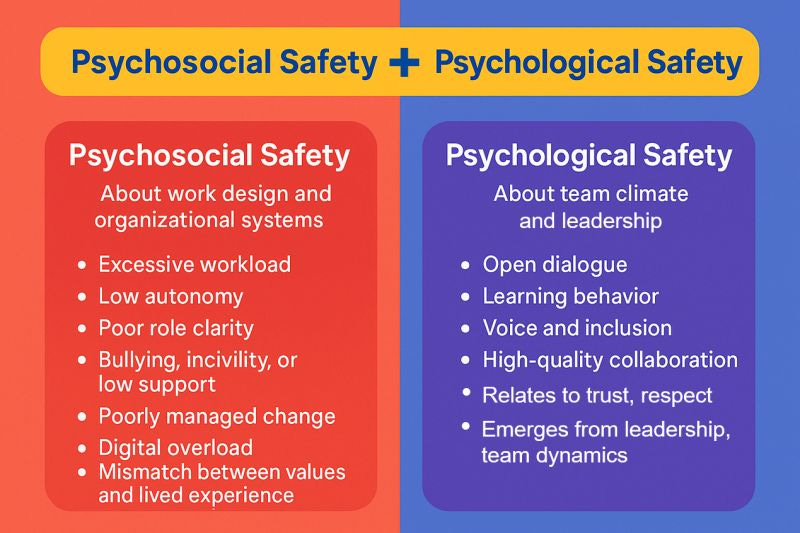
https://www.linkedin.com/feed/update/urn:li:share:7401229931713605633/
I have also written a few things this year, including this article on Trust and Performance and this one asking “Does Copilot Think You’re A Good Manager?” I think I am ahead of the curve on this one (a bit like my article The AI CEO which I published back in 2019!)
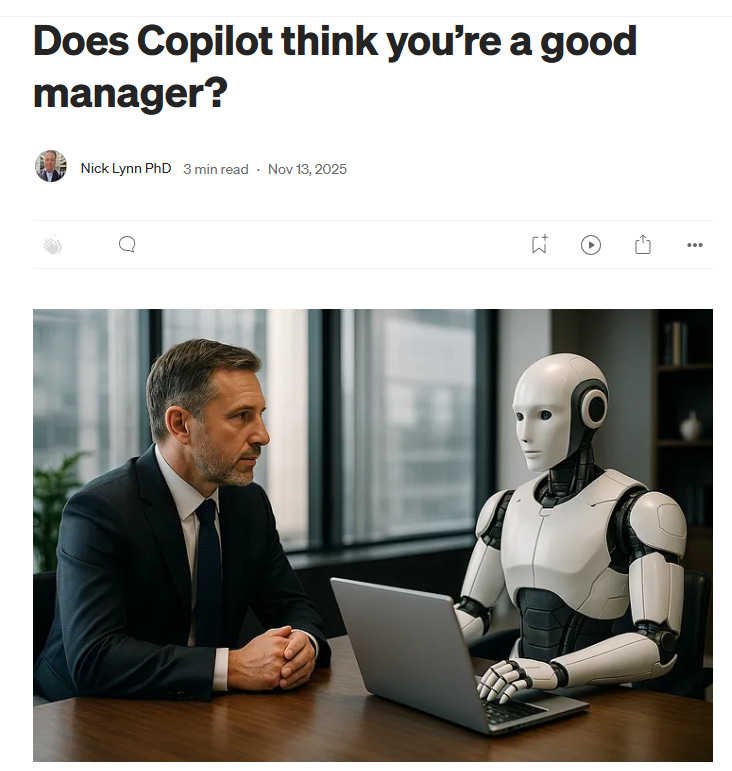
https://medium.com/@nickl4/does-copilot-think-youre-a-good-manager-10a0e86695af
As always, let me know what you make of all these!
Best wishes,
Nick